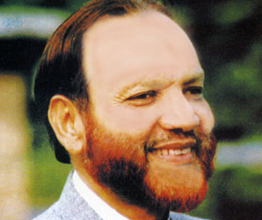
Khuram Murad was born on November 3, 1932 in Raisen area of Bhopal, a famous Muslim state in central India. His family belongs to Saharanpur and Muzaffarnagar. In 1937, his father was transferred to Gauharganj (Bhopal), then he stayed there till 1941. The education started with reading the Holy Quran with Urdu translation from my mother at home. In 1943, he entered the regular school in the sixth class. In 1947, after passing the matriculation examination, he entered Hamidiya College, Bhopal, in the first year of inter science and came first in the annual examination. Introduction to the congregation In November-December of the same year, on the invitation of a friend from the college, Hasan-ul-Zaman Akhtar, attended the gathering of Jamaat-e-Islami Bhopal. The Amir of the Jamaat in Bhopal was Syed Zaheerul Hasan. This gathering was the first formal introduction to the movement. In October 1948, he migrated with his family from Bhopal and came to Karachi via Delhi and Lahore. Affiliation with Islamic Jamiat Students After his arrival in Karachi, he reached the office of Jamaat-e-Islami in Karachi to establish a regular relationship with the local organization. Chaudhry Ghulam Muhammad asked to come the next day, and through Zafar Ishaq Ansari, arranged for a connection with the Jamiat-e-Islami Talaba. A few weeks later, Islami Jamiat Talaba became a member of Pakistan. After interpassing, he got admitted in Civil Engineering Department of NED Engineering College, Karachi. At the end of the year, he was elected as the moderator of Karachi Jamiat. First meeting with Syed Maududi Maulana Maududi visited Karachi for the first time after his release in July 1950. It was here that he met Maulana for the first time, and was welcomed by the congregation. In November of the same year, he participated in the third annual gathering of Jamiat held in Lahore and resigned from the organization of Karachi Jamiat in December. Nazim-e-Ala Islami Jamiat Talaba Pakistan On November 4, 1951, in the fourth annual meeting of the Jamiat (Lahore), Islami Jamiat Talaba was elected the third Nazim-e-Ala of Pakistan. In 1952, he was appointed as the head of the "Constitutional Committee" of Islami Jamiat Talaba Pakistan, which drafted the Jamiat's constitution under his leadership. One of his characteristics is that in December 1953, he applied for the membership of Jamaat-e-Islami on the same day he was discharged from the membership of the Jamiat. Employment and marriage Late Khurram Murad passed the civil engineering exam in 1953 from NED Engineering College with great honors and in January 1954, he joined an engineering company named Gaiman as an engineer. In September of the same year, Gaiman left the company and joined "Karachi Electric Supply Corporation". He got married on 8th June 1958, the Nikah ceremony was held in Bhopal. Your wife is one of the descendants of Nawab Siddiq Hasan, a famous religious figure of Pakistan and India. A trip to America In September 1957, he received a merit scholarship at the University of Minnesota, Minneapolis City (State of Minnesota, USA). On this basis, he went to USA to pursue higher education (MS) in engineering. During his stay at the University of Minnesota, he held discussions on Islam and Christianity with the Christian missionaries there. Attended churches and social functions there and gave speeches about Islam and Pakistan. It was here that I practiced speaking in English for the first time. You passed MS, Civil Engineering with A+ grade in first position. The special thing is to pass this exam in a minimum period of one month. Then he took a temporary teaching job in the university for eight to nine months to pay for his return home. A few weeks after returning from America, Khawaja got a job in "Associated Consultant Engineers" (ACE), a consulting company established by Azimuddin for major water, power and construction projects. At the same time, he participated in the weekly sessions of scholarly dialogues and debates at Zaylan Coffee House Sadar Karachi, and in these gatherings he took forward the discussion on the living issues of the movement. In 1959, Pir Elahi was elected as a member of the Municipal Council of Bakhsh Colony and tried his best to solve the problems of the people. In East Pakistan 1959 is an important year in your life, when your company decided to send you to East Pakistan after seeing your comprehensive report for damming the Brahmaputra river. In January 1960, he reached Dhaka along with his family. Jamaat-e-Islami was banned under martial law, so it established a social level relationship with the local leadership. Your company was working with an American engineering company on the Brahmaputra river. Both the companies directed you to go to Denver, USA as a project engineer to prepare the engineering report. On your return from Denver, you had the blessing of Umrah for the first time. After the end of Martial Law in June 1962, he started taking an active part in the activities of the Jamaat in Dhaka. Your membership was approved in the same year. Ameer Jamaat-e-Islami Dhaka Despite being from West Pakistan, he was elected Amir of Jamaat-e-Islami Dhaka in February 1963. From this, where this individual characteristic of Jamaat-e-Islami is clear that it has the quality of godliness and piety instead of caste, community and homeland, it also shows the dearness of Khurram Murad in the strange environment of the deceased. During the Emirate of the Dhaka Jamaat, he had a successful experience in bringing the organization and order of the Jamiat Talib Arabia established in Bangladesh under the influence of Tehreek-e-Islami. This organization proved to be a valuable springboard for the movement in Bangladesh. Later, his experiment was also successful in Pakistan. You were the head of the Jamaat-e-Islami "Parliamentary Affairs Department" for a period in East Pakistan, and the parliamentary training of the Jamaat's elected members of parliament.










 Mansoorah Multan Road Lahore, 54600