Birth and family
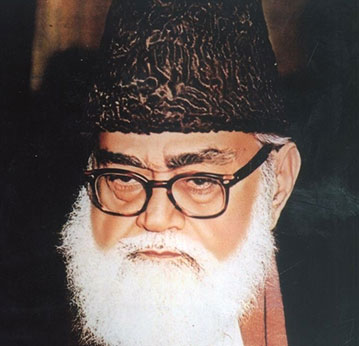
The year of birth of Syed Abul Ala Maududi is 1321 AH according to 1903 AH. Aurangabad is the place of birth in the Deccan and the ancestry belongs to a family of Sadats who originally came and settled at the famous place of Chisht near Herat. A famous elder of this family was Khwaja Qutbuddin Maudood Chishti who was the Shaykh al-Sheikh of Khwaja Moinuddin Chishti Ajmeri. Syed Maududi's family is called Maududi after the name of Khwaja Maudood Chishti.
The family in which he opened his eyes was a completely religious family. The life of both his respected father and mother Majda was colored in religious color. Syed Maududi was trained by his father with special attention. He gave them religious education himself.
Along with Urdu, Persian and Arabic, jurisprudence and hadith were also taught at home by Ataliq. Along with education, he also cared about moral reform. That is why Syed Maududi's father did not admit him to any seminary, but continued to teach him at home.
He kept his son under his direct supervision for the entire eleven years of elementary school and did not send him to any school or madrassa, but arranged for his education to be postponed at home so that due to the deterioration of the times in the madrasa and school, he Save your child.
Environment and training
Syed Maududi's respected father paid special attention to his training and trained him in a very good and excellent manner. In Syed Sahib's house, the clean language of Delhi nobles was spoken. Syed Maududi's father took great care to ensure that no inappropriate marketing words crossed his tongue. Whenever he felt such a word on his tongue, he would stop and make a habit of saying the correct word.
As far as mental structure and training are concerned, Syed Sahib's respected father would often tell him the stories of the Prophets and the important instructive events of the history of Islam at night. It tells the instructive stories of Indian history and the life situations of good people. It is obvious that the mind of Syed Maududi was deeply influenced by these words and feelings of goodness, goodness, greatness, nobility, exaltation of Islam and self-sacrifice were born in them and also a natural tendency to follow in the footsteps of the elders. was born
Madrasa education
At the age of 11, Syed Sahib was directly admitted to Madrasa Farqania Aurangabad in the 8th grade after proper completion of home education. At that time, his knowledge exceeded his classmates in all subjects, even though he was the youngest student in the eighth grade. After coming to the Maulvi class, Syed Sahib became familiar with and interested in modern sciences like chemistry, physics, mathematics, etc. And then the modern knowledge continued to expand.
The golden gates of childhood
Syed Sahib took the Maulvi exam in 1914 and passed, but this was a period when the financial difficulties of Syed Sahib's respected father had greatly increased. He left Aurangabad and came to Hyderabad due to the financial situation of the family due to his avoidance of lawyering and severe disharmony in religion. At that time, the president of Dar Uloom was Maulana Hameeduddin Farahi who was also the teacher of Maulana Amin Ahsan Islahi. Syed Sahib's father admitted him to Darul Uloom and went to Bhopal himself, and Syed Sahib continued to study in Darul Uloom, but this course of education could not continue for more than six months. One day it was reported from Bhopal that Syed Sahib's father, There has been a severe stroke.
So the traditional madrasah education ended and two and a half years of bitter experiences taught the lesson that to live with dignity in the world one must stand on one's own feet.
However, after the death of his respected father, Syed Maududi was worried about his livelihood. The respected father did not leave any property. It was not a noble family nor was courtship their profession. His family was a simple pious and noble family who based their livelihood not on jagirs but on their own strength.
Livelihood
After the death of his father, for the first time at this young age, Syed Maududi also realized that it is necessary to stand on his own feet to lead a life with honor in the world. Allah Ta'ala had blessed him with the great ability to write, so he decided to convey his thoughts to people through the pen and make it a source of livelihood. In this way, one will be a work for the welfare of Muslims and the service of Islam and the other will also become a means of livelihood, so he started his career as a journalist and then worked as an editor in several newspapers, including "Madina" newspaper in Bijnor (UP). ) "Taj" Jabalpur and "Al-Jamaiya" Delhi daily of Jamiat Ulema Hind are specially included. Once Maulana Muhammad Ali Johar also invited Syed Maududi to work in his newspaper "Hamdard" but he had old relations with "Al-Jamaiya" people, so he could not accept Maulana Muhammad Ali Johar's offer. Due to differences, he later had to leave the daily Jamiat. In political concepts, Syed Maududi was more compatible with the ideas of Maulana Johar.
As a child, he first read Allama Iqbal's famous poem "Shakwah". His father Syed Ahmad Hasan also taught him the political history of India. So when he became a journalist, he studied the country's situation directly. However, his family was very educated and knowledgeable. Especially the hatred towards the British was very high in this house. Due to these reasons, the movements that arose against the British in India at that time, such as the Khilafat Movement, the Satyagraha Movement and the Turk Mawalat Movement, etc. I actively participated in them. He wrote scathing articles against the British in support of the Turkish Muslims, pointed out the moral vices found in the Indian Muslims and also pointed out the political mistakes of the Muslim leaders. He gave many useful and practical suggestions for the reformation and development of Muslims and always worked for the reformation of Muslims. During the period of newspaper writing, Syed Maududi also learned English by his own effort and along with reading modern sciences, he also read books on Arabic literature, tafseer, hadith, fiqh, logic and philosophy from different teachers. In this way, his academic ability increased a lot and he became an expert in ancient and modern sciences.
The situation of Hindi Muslims was very painful for Syed Maududi. He used to criticize their poverty, helplessness and apathy. He wanted them to be true followers of Islam and present a model of true Islamic life to the world. At that time he wrote an article that all the weaknesses that have arisen among Muslims today are only because the Islamic spirit has gone out of them and they have forgotten what they are as Muslims. If Muslims follow Islam, they can convert the whole world into Muslims and become the most powerful in the world. Therefore, he used to think about various measures for the welfare of Muslims. Meanwhile, in 1925, when the Jamiat Ulema Hind decided to cooperate with the Congress, Syed Maududi left the editorship of the newspaper "Al-Jamayat" as a protest and separated from it. Because he was strongly opposed to united nationalism and considered Congress as a party against the interests of Muslims.
First authorship
At that time Syed Maududi was the editor of "Al-Jamaiya". One man, Swami Shradhananda, started the Shudhi movement, which aimed to convert Muslims into Hindus. Since this movement was based on hatred, enmity and bigotry and he had insulted the Holy Prophet in his book which no Muslim could tolerate, a Muslim killed Swami Shradhananda out of jealousy. This caused an uproar throughout India. Hindus began to attack the religion of Islam and declared that Islam is a religion of sword and violence. Syed Maududi was very sad about this situation. His heart was filled with the love of Islam and the pain of Muslims. He had great anxiety in his heart to serve Islam. On the same day, Maulana Muhammad Ali Johar gave a speech in Delhi's Jama Masjid, in which he expressed the need with great pain that someone should fully explain the issue of Jihad in Islam so that the misconceptions that are being spread against Islam today would be dispelled. They end. On this Syed Maududi thought that why not I should do this work. So he wrote a book called "Al-Jihad Fai-Islam". At that time Syed Maududi was 24 years old. At such a young age, such a Maarakat-ul-Araktab was an amazing and grand feat of yours for which you were praised from all quarters. Allama Iqbal said about this book: "This is an excellent treatise on the Islamic doctrine of Jihad and its law of peace and war, and I advise every learned man to study it."
Determined to reform the nation
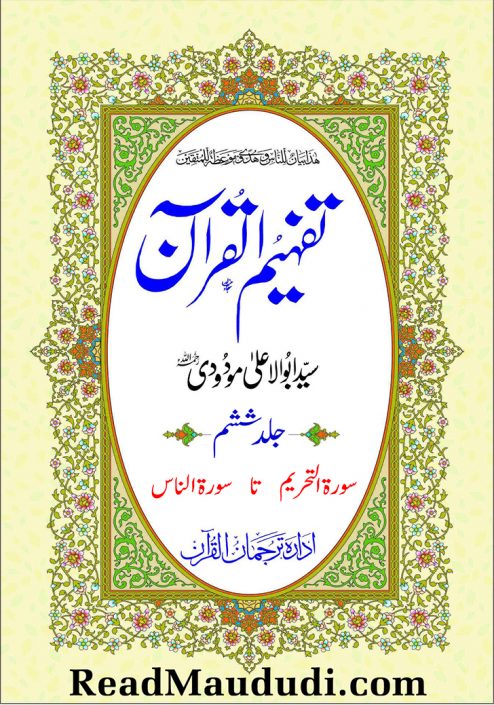
Syed Maududi had a lot of pain in his heart for Islam and he used to think about it day and night. In those days the condition of Muslims in India was worse than today. Syed Maududi wanted to reform the Muslims, so Syed Maududi left the editorship and newspaper writing of the daily Jameet, which had become the newspaper of the Congress Muslims, and went to Hyderabad Deccan. During his stay in Hyderabad, Syed Maududi wrote various books, along with this, he studied the political conditions of India and the condition of the Muslims deeply, during which he also continuously pondered on various measures to reform the condition of the nation. Finally, he published the magazine "Tarman Al-Qur'an" from Hyderabad in 1932 for the purpose of reforming the nation. What they wanted to do for the good of the Muslims was to first break the influence of Western nations, Europe's ideas and methods from the minds of the Muslims, then this thing in their minds. It should be stated that Islam is a complete code of life that guides man in every problem of life.
Therefore, in 1935, he wrote a wonderful book in support of the Islamic curtain named "Pirda" and shut the mouths of those people who raised various objections to the Islamic curtain due to Europe's fascination. In addition, he wrote articles on "Tanqihat" and "Tafhimat" through which he removed the influence of Farangi culture among the educated Muslims.











 Mansoorah Multan Road Lahore, 54600