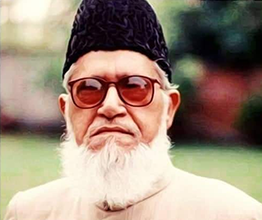
Mian Tufail Muhammad Early life and family conditions Mian Tufail Muhammad was born in November 1913 in Safdarpur Arayan, a village in Kapurthala state of East Punjab, in a farming family with a religious orientation. He had a respectable position. Elders of his family were numberdars and thaldars in the village, Mian Sahib's uncle Chaudhary Rahmat Ali Kapur was also elected member of Thala Assembly. Apart from being a school teacher, your father also did farming. Mian Tufail Muhammad was the eldest among his siblings and in his autobiography "Observations" states that during his childhood he had little contact with the children who played and made noise in the streets. On the contrary, after completing the curriculum activities, he used to spend most of his time in the gatherings of elders and influential people, due to which seriousness, thoughtfulness and prudence developed in his nature. Educational background Mian Tufail Muhammad did his primary education from his village school, a school in the middle town of Nadala. Passed matriculation examination from Randhir High School, Kapur Thala and FSC (Pre-Engineering) Randhir Inter College, Kapur Thala with distinction marks and got scholarship. BSc Honors with Mathematics and Physics from Government College, Lahore. In 1937, he obtained second position in LLB from Punjab University Law College, Lahore. Former Chief Justice of Pakistan Muhammad Munir is one of your teachers. After completing his LLB, he started practicing law in Jalandhar with Sheikh Muhammad Sharif (later a judge of the Supreme Court of Pakistan). After working with him for a year, he moved to Kapurthala and started his independent practice there. He was the first Muslim (LLB) lawyer in Kapurthala state. Join the congregation He was a regular reader of Tarjaman al-Qur'an, a magazine published by Syed Abul Ala Maududi. When Jamaat-e-Islami's founding meeting was scheduled, you attended the meeting and dedicated your services to the Jamaat. In view of the party needs, on 21 January 1942, he gave up advocacy and made trade a means of livelihood. According to Mian Sahib, this period passed with economic hardship but spiritual peace. On the suggestion of Malik Nasrullah Khan, the Ameer of Jamaat-e-Islami Lahore at that time, he was appointed as the Central Qayyim (General Secretary) and on 17th April 1944, he reached Dar-ul-Islam and took charge of the work of the Jamaat. After becoming the Qeem Jamaat, he paid special attention to organizational matters, activated the members of the Jamaat, traveled all over India to contact the members and workers and guide them in connection with invitations and organization. During this time, you used to meet religious and political leaders and convey invitations to them. Difficulties of incarceration Due to his prominent position in Jamaat-e-Islami, he was arrested many times, but the first arrest was on October 4, 1948, when he was arrested and transferred to Kasur Jail, and on October 14, he was arrested due to his active participation in the movement to implement the Islamic system. was sent from Kasur to Multan Jail. In April 1950, the period of detention was extended but during this time The Lahore High Court in a judgment declared that "under the Punjab Public Safety Act no person can be imprisoned for more than eighteen months". So on May 28, he was released from Multan Jail along with Maulana Maududi. During his imprisonment in prison, he studied the Holy Quran from Syed Maududi from Surah Yusuf to Surah Al-Nas, read the famous book of Hadith Mu'ta Imam Malik with text from Maulana Amin Ahsan Islahi Sahib and learned Arabic from him during that time. Services in congregation Mian Sahib served as Qeem Jamaat till 1965. In January 1966, Naib Amir took charge of the Jamaat. During this time, he was also the Amir of Jamaat-e-Islami West Pakistan, while many times he performed the duties of acting Amir in place of Syed Maududi. When the Joint Opposition (COP) was formed in 1965, Mian Sahib was one of its central leaders. He visited East and West Pakistan along with other leaders to create democratic consciousness in the people and to run a strong movement in favor of democracy in the country, this movement challenged Ayub Khan's dictatorship for the first time in the country. Later, Mian Sahib played a very active role in Pakistan Democratic Movement (PDM) and Democratic Action Committee (DEC) on behalf of the party. The result of these movements was that the Ayyubid dictatorship ended in 1969 and the first general elections were held in the country in 1970. In July-August 1971, when no leader from West Pakistan was ready to go to East Pakistan, Mian Sahib made a detailed tour of East Pakistan and conveyed the message of unity and Islamic brotherhood to the people there. In November 1972, he took oath as the Ameer of Jamaat-e-Islami Pakistan. Mian Tufail Muhammad Sahib was the direct successor of Maulana Syed Abul Ala Maududi. In 1972, when Mian Tufail Muhammad was elected as the Ameer of the Jamaat, Maulana Maududi said that "I expected that Mian Tufail Muhammad would be elected as the Ameer and the members of the Jamaat have done the right elections, he has been my confidant." After becoming the amir of the Jamaat, he started a campaign to renew the Jamaat's basic literature through training centers. Organized a monthly ten-day training center at the center for training workers and direct contact with leadership. In the same way, he started a new series of Quranic circles in the whole country and these circles were established in at least three thousand places. In March 1973, a coalition of opposition parties












 Mansoorah Multan Road Lahore, 54600